AramaRoots (naturama) Silver Workshop - Kokoro Kato

In the workshop, where a large work desk is set up, we talk about the precision of handwork and the stoic creative attitude, with well-used tools piled up.
The silver workshop we visited this time, AramaRoots (naturama) , is an accessory brand founded by Kato Shinshi in 2000.
His pieces, created using a variety of approaches, continue to capture the hearts of many fans as accessories that can be worn with love for a long time. His workshop is located in a quiet residential area west of Mt. Tennozan. Blessed with abundant nature, this mystical place that has been the setting for many historical events is the perfect place to cultivate creative inspiration. Kato-san has a craftsman's spirit, but he also has many hobbies and a playful side, and this interview conveys the passion for craftsmanship that lies beneath.
Turning my desire to create three-dimensional pieces into accessories
--Have you been good at making things since you were little?
My family moved to Kyoto when I was young, but both of my parents were originally from Izumo, and my grandfather was a craftsman who made Buddhist statues and altars.
I still have vague memories of my grandfather's workshop and the smell of wood. I was the only relative to inherit that legacy, and as a child I was given paper and pencils instead of toys, and was content to draw manga.
I used to create things that surprised people around me. I went on to study art in high school, and from then on I wanted to become a manga artist, so I kept drawing. In the end I gave up on that dream, but after that I worked as a character designer at a game company, worked as a freelance graphic designer, made objects as a hobby and sold them at flea markets, and so on, and I've been involved in creation in a variety of ways.
─Though there were many twists and turns, you were always dedicated to creating. Did you end up becoming a jewelry designer?
When I reached my 30s, I wanted to learn three-dimensional modeling in a way that would allow me to properly pursue my career, so I started attending a vocational school for jewelry while working. I was over 30, and I knew I wanted to make a living from this, so I studied voraciously.
--The results were seen early on.
I worked hard to get people around me to help me, and thankfully, I started receiving orders from friends at an early stage.
After receiving an order, I would learn from my teachers at school about any parts I didn't understand. In 2000, when I started up "AramaRoots Silver Workshop," I was still in school and working as a salaryman during the day, but gradually orders started to increase and I was able to shift my focus to just silver.
In the end, I went to school for 3-4 years and learned almost everything I needed to know before I dropped out.

To this day, the brand continues to produce silver accessories from its early days due to its loyal fan base. It was even voted second in a reader poll for cutting-edge brands in the popular accessory magazine "The Ultimate Guide to Silver Accessories." The necklace on the right, "Vajra Standard," is based on a tantric ritual implement. It is a piece that is still available at Craft Cafe.
─Where does the brand name "Arama Roots" come from?
The name is a combination of the Ainu word "Aram," meaning "my soul," and the English word meaning "path, origin." It means "the origin of my soul." It is imbued with the desire to create soulful pieces that can become the roots of accessories for the next generation.
The reason I use Ainu words is because I initially wanted to make jewelry with Ainu patterns, but after a few pieces I got bored and stopped making them (laughs).
After that, I started making hard-edged silver accessories for men, and elaborate pieces with gimmicks, such as ones with springs inside that move.
--That's a completely different style from what you have now.
Being a boy (lol), I like mechanical things and robots, but there was a problem that the effort involved was not worth the price (lol).


At the request of an actor client whom I met through silver accessories, I created a director's chair for the world-famous director. The chair, with silver angel objects attached to both ends of the backrest, was also featured in the pamphlet for the movie "Achilles and the Tortoise." This work was created in 2008.
Here is our blog from that time.
The joy of those who use my work is my motivation for creating.
─What prompted you to shift to your current focus on accessories for women?
It started when we had more opportunities to sell our products at events held at department stores. Because it is a department store, most of the customers are women, and I thought that we couldn't grow as a brand unless we focused on women.
Gradually, I made the lines thinner and added more nature-themed designs, such as butterflies and flowers.
--Did you have any reservations about creating something with a completely different style?
At first, I did (laughs). But, when I saw how happy my customers were when I communicated with them, and when I realized how much they cared for my products, it made me really happy and encouraged me.
Also, my girlfriend at the time...she's now my wife, would tell me what she wanted, so I tried to listen to her as much as possible.

Kato's wife, Naomi. The photo shows the Kyoto Art Flea Market, which is held every spring and autumn in Kyoto (taken on March 20, 2016).
--Your wife is now in charge of sales and the website for "Arama Roots"! That's really where your partnership began.
That's right. I started making cats at her request. I love cats and have always had them as pets, but I never had any intention of turning them into artwork.
The world was filled with these kinds of realistic, three-dimensional objects, so I wasn't interested in making them myself. What I was originally interested in was complex designs.
However, after making accessories for over 10 years, I have acquired the skills to add my own personality to them, so I thought I would give it a try.
─What are the characteristics of the cats that Mr. Kato works on?
Mine is probably based on a cartoon. I create them using actual cats as models, but they're not exactly realistic cats; their heads and eyes are a little bigger, and their bodies are a little shorter. I try to add my own kind of cuteness to them, or rather, I emphasize the parts that I find cute.
However, if you overdo it, it can become childish, so we have to be careful about the balance. It's a cat for adult women.

The number of designs and items in the cat series has increased. Model changes are sometimes made through dialogue with customers.

Her beloved cats Guri and Ratu, who also serve as models for her work, are 4-year-old siblings (as of May 2016). The calico cat is a female, Guri, and the brown tabby cat is a male, Ratu.

Kato says, "The piece with a thin child motif is based on Gri, and the slightly rounder child is based on Latu (laughs)."

These affordable cat earrings are popular. The floppy cat earrings on the left are modeled after "Guri," and the round cat earrings on the right are modeled after "Latu."
─It started with cats, and now your animal series has expanded.
I create many items based on customer requests, so I've added dogs and rabbits. I've been getting more and more requests for dogs in particular. There are still not many artists who make dogs, so I think they're getting attention.
--All of your works are truly adorable, but what do you keep in mind when creating them?
Since the motif is a living creature, it is important to create an atmosphere that seems to speak to you. After the mold is completed, the final process is to smoke it and polish it, and we finish it carefully, down to each and every strand of fur, as if we are breathing life into it.
The eyes in particular are given a shiny, smoked finish to give them a lifelike glow. That's why even if they are made using the same mold, each one will have a different expression when completed. It would be my greatest reward as an artist if people would grow attached to my dolls as if they were their own.


This dog ring realistically captures the adorableness of a miniature dachshund . Silver is poured into a mold created with exquisite deformed detailing, utilizing the artist's drawing skills. After oxidizing, the ring is polished for several times longer than usual to create a finished product.
─Another representative work of yours is your Morpho butterfly accessory series. It was recently used in a TV drama, and I heard you've been inundated with orders.
I've settled down now (laughs). I came across some morpho butterfly wings sandwiched between glass and made into jewelry among the antiques favored by British aristocrats, and I wanted to do something like that using modern technology, so I researched it.
The material used was Morpho butterfly wings, which could not be used for specimens, but as they are not available in Japan, I had to start from scratch and find out how to import them.
It took a lot of ingenuity to recreate it using resin instead of glass, but because I have been making resin accessories for a long time and have acquired the skills, I was able to come up with a skillful processing technique. I am proud to have created something that no one else can imitate.
--How you managed to create such beauty using resin is a company secret.
Of course (laughs). But, although I've been making them for five years, it's only recently that I've been able to produce them with impeccable quality.
During that time, the quality of materials such as resin has improved dramatically. The products we make now are close to perfect. So, if a customer who previously purchased a product requests it, we will maintain it and return it to almost new condition, paying only the cost of the materials.
We offer maintenance services for all of our products, not just Morpho butterflies, as we don't use any materials that cannot be repaired.

These accessories are made using the wings of the Morpho butterfly, said to be the most beautiful butterfly in the world. The mysterious and vibrant metallic blue of the wings is not produced by pigments but by the intriguing microstructure on the surface of the wings, and the appearance changes depending on the angle of the light.
What we want now is the ability to freely decorate jewelry
--It's clear that each of your works is packed with your own unique style. It seems like you're taking on new challenges with each piece.
I've always had the desire to develop new techniques. I want to bring my goals and dreams to the world in my own way. In particular, I've always wanted to add color to accessories, and that's how I came across the Morpho butterfly, but resin is not something that will remain unchanged forever.
The best way to add color is to incorporate glass objects. Then, I happened to come across a book in a second-hand bookstore that featured the works of René Lalique, a French jewelry artist active in the 19th and 20th centuries. The more I researched it, the more I wanted to master this technique.

In October 2016, Kato went to France to experience making glass art. This experience led him to study in France every year.

This is the beginning of a new story for Aramaruts. It's an exciting moment.
I want to make things that can only be made by hand. I also want to offer things that are not high-end, but pop and familiar, but not cheap. I thought this technique was perfect for that. The principle is the same as the cloisonné technique in Japan, but there is something about it that cannot be explained simply by that.
I would love to incorporate this technique into my own expression, but the only place I've found where I can learn it is France.
─I can't wait to see what new horizons Kato-san will reach.
I feel like now is the time to take action, but the conditions just aren't right. Fortunately, I've always been the type of person who, once I become interested in something, I go for it headfirst. I still have the desire to take on new challenges. I'm already 50 years old, so I want to master this technique as my final challenge.

René Lalique was a French jewelry artist active throughout both the Art Nouveau and Art Deco eras, which emerged from the late 19th century to the early 20th century. The noble brilliance of his enamel jewelry (jewelry made from a combination of glass and metal), created using intricate techniques, continues to fascinate people today.
In Japan, apart from the traditional craft of cloisonné, there are still few everyday accessories that combine glass with metals such as silver, and Kato believes that the works of Rene Lalique will provide inspiration for her future creative endeavors.

In February 2015, she exhibited at the Milano Pret-a-Porter fashion fair in Milan, Italy. Although it was undecided at the time of the interview (May 2016), she will be spending two weeks in France in September 2016 learning how to make glass accessories.
Mr. Kato is a calm and rather quiet person, but he has an incredible spirit of challenge and drive.

In front of the "Milano Pret-a-Porter" event poster.
--You're still a long way from turning 50. But you seem very positive.
No, when I was little I was a shy and timid child who thought, "No matter what, I'm no good." But one day I realized that thinking like this was no good, that I was only losing out! I was bringing all the bad results upon myself. I still remember the moment I realized this clearly and decided to change my way of thinking from now on. It was before I started elementary school.
─That's pretty precocious (laughs).
Maybe. But I have no memory of how specifically things changed after that, or whether my life started to move in a better direction. But I did become more positive in my way of thinking.
-What about life?
No, it's not something that can be solved by just thinking "it'll work out somehow" (laughs). However, I think the basic thing is to have the determination to do something and put in the effort to make it work. Aside from a handful of geniuses, that is.
I think basic skills are very important, and when I decided to make accessories I studied intensively at school, so although it took me a while, I think that's why I'm still able to work as an artist today.
I've taken many detours, but for example, I owe it to drawing manga to be able to give shape to the things I imagine in my head, and all the hard work I've put in has helped me to become who I am today.
--What kind of developments do you aim for in the future?
Being introduced to people from different industries through Craft Cafe and being able to connect with them has been a really great inspiration.
Everyone is getting bigger and bigger, and I think it's amazing, and I also see them as rivals. I myself have been blessed with connections with truly wonderful people, and that's why I can't afford to lose.
As it is a small brand run by one artist, we cannot expand our reach, but I would like to create works for the world in the future. To achieve this, I would like to add a European nuance to my current works, so it is essential that I acquire new techniques.
And eventually, I would like to appear on Jonetsu Tairiku (laughs). Above all, the most important thing is to continue creating works that I can be satisfied with and that will please as many customers as possible.
─I look forward to it. Thank you very much.
"I'm not a genius, I'm just an ordinary person. I've come this far through hard work, connections, and luck," says Kato. However, his creativity as an artist, which allows him to focus on what is required and elevate it into original works, is also a rare talent.
His creative attitude of continuing to challenge himself to create what he wants while flexibly responding to needs is what you'd expect from an artist. I'm even more excited to see what kind of works he will create in the future.
(Images of my beloved cats Guri and Ratu, and images of the exhibition in Milan, Italy, were provided by Aramaruts.)
(Interview date: May 19, 2016 / Text: Writer Morimoto Tosei)
Profile of Kato Kokoro from AramaRoots (naturama)
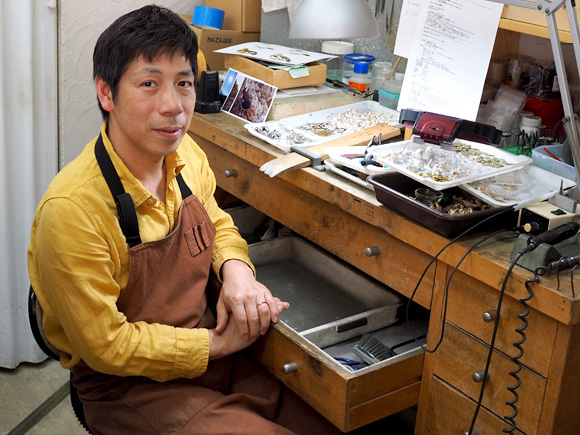
Born in Izumo City, Shimane Prefecture in 1967. Influenced by his grandfather, who was a Buddhist statue craftsman, he has a stronger interest in making things than most people and is blessed with a rich imagination.
After graduating from an art school, she moved to Kyoto and studied graphic design and object creation while also enrolling in the Japan Jewelry Craft Academy, where she studied the production and design of silver accessories.
He established the Silver Workshop Aramarutsu in Oyamazaki, Kyoto in 2000. He delivers only the works that he is satisfied with to his customers.
A list of accessories by Kato Kokorozu of Silver Studio Aramarutsu